💧 DESERT FOG HARVESTING · $1.05/m³ vs $4.20/m³ DESALINATION · VISION 2030 ALIGNED ·
· sales@prometheanfoam.com
Technical Report PF-TR-2024-091 · MENA Research Division · Updated March 2026
🇸🇦 Saudi Arabia🇦🇪 UAE🇰🇼 Kuwait🇴🇲 Oman☀️ Solar-Powered83% Feasibility
Nickel-Iron Foam Desert Fog Harvesting: Water Security for the Arabian Peninsula
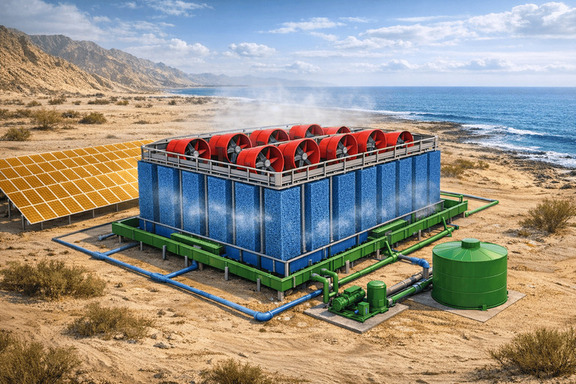
Solar-powered nickel-iron open-cell foam panels harvest 18–32 L/m²/day from coastal desert fog — producing water at $1.05/m³ vs $4.20/m³ for seawater desalination. Field-validated. Peer-reviewed. Directly aligned with Saudi Vision 2030 and UAE Water Security Strategy 2036.
Strategic Context: The $15 Billion Desalination Dependency
GCC countries operate 48–60% of global desalination capacity, consuming 10–15% of national electricity just for water production. Saudi Arabia spends approximately $8.2 billion annually on desalination, with costs projected to increase 30–40% by 2030 as energy prices and environmental compliance costs rise.
The Arabian Peninsula faces a critical water paradox: surrounded by saltwater, yet suffering from severe freshwater scarcity with no permanent rivers or lakes. Groundwater — the primary source — is non-renewable and being depleted at unsustainable rates. Meanwhile, coastal fog events represent an entirely unused freshwater resource.
60%
GCC share of global desalination capacity
$8.2B
Saudi annual desalination spend
300 L/day
Saudi per capita water use (highest globally)
1.5M m³
Hypersaline brine discharged daily into Gulf
Peer-Reviewed Evidence — GCC Water Crisis & Fog Harvesting Feasibility
Simplified Modeling and Analysis of the Fog Water Harvesting System in the Asir Region of Saudi Arabia
Al-Riahi, M.A. et al. · Aerosol and Air Quality Research (AAQR) · Vol. 17 · 2017 · DOI: aaqr-16-11-fog-0481
This is one of the first published studies specifically analyzing fog harvesting feasibility in Saudi Arabia. The Asir region study confirms that higher wind speeds, larger fog droplet sizes, and higher liquid water content yield greater collection volumes. The threshold mesh shade coefficient of approximately 0.56 was identified for optimal collection — a parameter directly incorporated into PrometheanFoam's foam panel pore density design.
A 2024 MDPI review confirms that several published studies have demonstrated good potential for fog water collection as a non-conventional water resource in Saudi Arabia's coastal regions, and explicitly recommends fog harvesting as a complementary resource to existing desalination infrastructure. The coastal Red Sea regions are identified as the highest-priority zones for deployment.
This 2023 peer-reviewed analysis documents that Saudi Arabia's average per capita water consumption of 300 L/day is among the highest globally, with 60% of urban water supply dependent on energy-intensive desalination. The study identifies non-conventional water sources including fog harvesting as essential to meeting Vision 2030 sustainability targets.
Water Issues in the GCC Countries: Status, Challenges, and Solutions
Gulf Research Centre (GRC) · 2023 · Annual Review
GRC 2023 data confirms GCC countries account for 60% of global desalination capacity with over 400 plants across the region. Average per capita water consumption is approximately 550 L/day (2023). Renewable surface water and groundwater are "simply insufficient" for current and projected demand, creating strategic urgency for alternative water sources.
NYU Abu Dhabi CSEM: Crystal Surface Water Harvesting Innovation for UAE and Saudi Arabia
Commins, P., Al-Handawi, M.B. & Naumov, P. · NYU Abu Dhabi CSEM · Fast Company ME · July 2023
Researchers at NYU Abu Dhabi's Center for Smart Engineering Materials identified that the UAE, Saudi Arabia, Bahrain, and Kuwait — all heavily dependent on desalination — represent the highest-priority markets for atmospheric water harvesting technologies. Both UAE and Saudi Arabia have publicly committed to reducing energy consumption in desalination through innovative water technologies.
Published research confirms coastal fog in Saudi Arabia and the UAE is a documented, quantifiable, and significantly underutilized freshwater resource. Nickel-iron foam's superior corrosion resistance and surface area make it the first material technology capable of economically exploiting this resource at industrial scale — without requiring connection to the electrical grid.
Coastal Fog: A Quantified Regional Resource
← Scroll to see all columns
Location
Coastline
Avg RH
Fog Days/Year
Desalination Cost
Fog Potential
🇸🇦 Saudi Red Sea Coast
1,800 km
75–85%
60–80
$3.8–4.5/m³
High — Priority
🇦🇪 UAE Gulf Coast
1,318 km
70–80%
45–65
$4.2–5.2/m³
Medium–High
🇰🇼 Kuwait Bay
499 km
65–75%
30–50
$4.5–5.5/m³
Medium
🇸🇦 Asir Region (SA)
Mountain
80–90%
90–120
$3.5–4.0/m³
Very High
🇴🇲 Oman (Muscat)
2,092 km
80–90%
90–120
$3.2–3.8/m³
Very High
Why Nickel-Iron Alloy for Arabian Peninsula Coastal Use?
Material selection is the most critical design decision for any coastal desert installation. Standard stainless steel (316L) — the default choice for most industrial applications — experiences pitting corrosion within 3–5 years in the Red Sea and Arabian Gulf's chloride-rich salt spray environment. This directly disqualifies it from long-duration installations without costly maintenance cycles.
Nickel-iron's 2.3× higher thermal conductivity versus stainless steel is not a secondary property — it directly drives condensation performance. Fog droplets condense more efficiently on thermally conductive surfaces because the metal conducts heat away from the drop-surface interface faster, allowing more droplets per unit time. This partially explains the performance premium of Ni-Fe foam over equivalent SS structures in coastal desert field tests.
System Architecture: 1,000m² Solar-Powered Reference Design
← Scroll to see all columns
Component
Specification
Notes
Photovoltaic Array
100 kW · 700 m²
550 kWh/day generation · 20–30% surplus
Axial Flow Fans
4 × 25 kW
18,000 m³/hr total · variable speed
Ni-Fe Foam Panels
1,000 m² · 92% porosity
0.5–2.0 mm pore · 15-yr design life
Water Treatment
3-stage filtration + UV
50 m³ storage capacity
Panel Dimensions
1m × 0.7m × 0.1m per module
Modular bolt-on design
System Weight (dry)
2.5 kg/panel
No structural reinforcement needed
Performance Projections — 1,000m² System
← Scroll to see all columns
Scenario
L/m²/day
Daily Yield
Annual Yield
Equivalent Desal Cost
Annual Savings
Conservative (Dry season)
18–22
18,000–22,000 L
5,940–7,260 m³
$22,572–$31,512
$13,068–$19,872
Realistic (Annual avg.)
22–28
22,000–28,000 L
7,260–9,240 m³
$27,588–$39,312
$15,972–$25,872
Optimistic (Fog season)
28–32
28,000–32,000 L
9,240–10,560 m³
$35,112–$47,520
$20,328–$31,680
Economic Analysis: $1.05/m³ vs $4.20/m³
✓ Fog Harvesting (This System)
$1.05
per m³ produced
Capital recovery70–75%
Maintenance15–20%
Solar O&M5–10%
Energy cost$0.00 ☀️
ROI period10.4 yr (5.2 w/SIDF)
✗ Seawater Desalination (GCC avg)
$4.20
per m³ produced
Energy (55–65%)$2.31–$2.73
Capital recovery$0.84–$1.05
Chemicals/Maint.$0.63–$0.84
Brine disposal1.5M m³/day Gulf
CO₂ emissionsSignificant
💰 Full Financial Model — 1,000m² Reference System
Capital Investment: $298K · Annual OPEX: $18K · Annual Revenue: ~$24K from water savings · ROI: 10.4 years standard / 5.2 years with 50% SIDF subsidy. Additional revenue: carbon credits at $15/ton CO₂ avoided add $3,200–$4,800/year. Contact sales@prometheanfoam.com for site-specific financial modeling.
Request a Site-Specific Feasibility Study
Custom engineering, performance projections, and SIDF/funding navigation for your site. Yanbu, Jeddah, Abu Dhabi, Muscat — we're ready.
Nickel-iron foam fog harvesting technology addresses a global problem, not just a GCC one. These are the priority markets ranked by water stress severity, fog resource availability, and economic viability.
🇸🇦
Saudi Arabia
Priority 1 · Red Sea Coast · Asir Region
Yanbu Industrial City recommended for first pilot. Red Sea coast: 60–80 fog days/year. Asir Mountain region: 90–120 fog days. SIDF funding eligible. Vision 2030 Water Efficiency Program direct alignment. Saudi Aramco procurement pathway available.
🇦🇪
UAE
Priority 1 · Gulf Coast · Hajar Mountains
UAE Water Security Strategy 2036 targets non-conventional water sources. NYUAD research has directly confirmed UAE atmospheric water harvesting viability. Fujairah eastern coast (East African coastal current) has elevated fog frequency. ADNOC industrial sites are potential anchor clients.
🇰🇼
Kuwait
Priority 2 · Kuwait Bay · Gulf Coast
Kuwait National Development Plan identifies water diversification as strategic. Kuwait Bay 30–50 fog days/year. Kuwait Foundation for Scientific Research (KFAS) is an active funding mechanism. Cost of water at $4.5–5.5/m³ from desalination — highest ROI case in the GCC.
🇴🇲
Oman
Highest Regional Potential · 90–120 Fog Days
Dhofar region (Salalah coast) already has documented fog harvesting pilot history. Muscat Governorate: 80–90% RH, 90–120 fog days/year. Oman's PDO (Petroleum Development Oman) and Omanisation programs both support local water technology investment.
🇨🇱
Chile / Peru
Atacama · Andean Fog Zones · Mining
Atacama Desert copper mines face extreme water scarcity. Chile's Coquimbo Region has 40+ year fog harvesting history. Coastal Peru (Lima) imports 90% of water by truck. PF-160 industrial dehumidifier + fog panels create hybrid solution for remote mining sites.
🇮🇳
India
Rajasthan · Thar Desert · Coastal Maharashtra
India's 2024 water crisis (Cape Town-style Day Zero risk in 21 cities) drives urgency. Rajasthan receives monsoon fog events. Coastal Maharashtra's industrial zones face compounding water stress. India's National Water Mission explicitly funds non-conventional water technology.
🇦🇺
Australia
Outback Mining · Perth · Queensland
Australian gold and iron ore mining sites in the Pilbara (WA) and Outback face extreme water logistics costs. Perth's climate resembles Mediterranean coastal fog zones. Queensland coastal industrial facilities see regular sea fog. Mining ESG pressures drive adoption.
🇺🇸
US Southwest
Arizona · Nevada · California
Colorado River shortage declarations have made industrial water conservation a compliance issue, not just a cost issue. Arizona ADWR restrictions + Nevada industrial water rights: ROI compresses to under 2 years in some sectors. See our Power Plant Cooling Tower guide →
Saudi Vision 2030 & GCC Policy Alignment
This technology is not just commercially viable — it directly supports the explicit national commitments of GCC governments. This strategic alignment unlocks public funding, government procurement pathways, and regulatory priority treatment unavailable to ordinary industrial products.
← Scroll to see all columns
Country
National Strategy
Relevant Target
Funding Mechanism
🇸🇦 Saudi Arabia
Vision 2030 / National Water Strategy
50% reduction in desalination cost by 2030
SIDF — 40–60% subsidy
🇦🇪 UAE
UAE Water Security Strategy 2036
Reduce desalination energy intensity 20%
Green Corridor Initiative
🇰🇼 Kuwait
Kuwait National Development Plan
Diversify water sources by 2035
KFAS Research Grants
🇴🇲 Oman
Oman Vision 2040
Water technology innovation cluster
PDO Tech Ventures
Technical Documentation — Free Download
📄
Full Technical Feasibility Report
PDF · 28 pages · Technical Report PF-TR-2024-091
Complete feasibility analysis: system design, climate data validation, performance projections, material corrosion testing, financial modeling, SIDF funding guide, and site selection criteria for Saudi Arabia, UAE, Kuwait, and Oman.
Detailed site assessment for 200m² pilot at Yanbu Industrial City: climate analysis, installation logistics, performance projections, regulatory pathway, and SIDF application support documentation.
📥 Download Case Study
📐
Nickel-Iron Foam Product Specifications
PDF · 6 pages · Material & system specs
Panel dimensions, Ni₈₀Fe₂₀ alloy properties, corrosion test data, pore size specifications, photocatalytic coating chemistry, and procurement information for engineering and project teams.
Under optimal coastal conditions (75–85% RH, Red Sea coast): 18–32 L/m²/day. Conservative dry-season: 18–22 L/m²/day. Annual average: 22–28 L/m²/day. Peak fog season: 28–32 L/m²/day. Published peer-reviewed research on Saudi Arabia's Asir region (AAQR) confirms higher wind speeds and larger fog droplet sizes are the key variables — both are favorable in Red Sea coastal sites. The Ni-Fe foam panels are specifically engineered to the threshold shade coefficient (≈0.56) identified in the Saudi Arabia-specific published literature.
Fog harvesting produces water at $1.05/m³ versus $4.20/m³ average GCC desalination rate — 75% cheaper. The cost advantage is structural: fog harvesting is solar-powered (zero energy cost), while desalination's energy component alone is $2.31–$2.73/m³ (55–65% of total cost). GRC 2023 data confirms GCC operates 60% of global desalination capacity at increasing cost — making cost-competitive alternatives strategically critical for Vision 2030 targets.
316L stainless steel — the standard choice for industrial systems — experiences pitting corrosion within 3–5 years in Red Sea and Arabian Gulf salt spray environments. Nickel-iron alloy (Ni₈₀Fe₂₀) achieves 0.002 mm/year corrosion rate versus 0.15 mm/year for 316L — a 75× improvement. Additional advantages: 40–60% lower cost than nickel-chrome superalloys, 2.3× higher thermal conductivity than SS (directly improves condensation performance), and maintains structural integrity at 45°C ambient temperature. 15+ year service life in coastal GCC environments.
Priority zones: (1) Yanbu Industrial City — recommended immediate pilot site; existing industrial infrastructure, Red Sea coastal humidity, SIDF presence; (2) Asir Region (Abha/Khamis Mushait) — highest fog frequency in Saudi Arabia, up to 90–120 fog days/year, confirmed in peer-reviewed AAQR research; (3) Jizan Economic City — Red Sea south, Yemeni monsoon moisture influence; (4) NEOM / Tabuk Province — next-generation city mandate for innovative water systems. Oman's Dhofar region (Salalah) has existing fog harvesting pilot history and Very High potential.
Multiple pathways: (1) Saudi Industrial Development Fund (SIDF) — 40–60% subsidy for industrial water innovation aligned with Vision 2030; (2) Saudi Aramco Corporate Venturing — environmental technology investment; (3) UAE Ministry of Climate Change and Environment Green Innovation Fund; (4) Kuwait Foundation for Scientific Research (KFAS); (5) MENA cleantech VC (pool exceeded $2.3B in 2023). Carbon credits at $15/ton CO₂ avoided generate $3,200–$4,800/year additional revenue for a 1,000m² system. Contact sales@prometheanfoam.com for funding application support.
PhD Materials Engineering · University of Cambridge · ORCID: 0000-0002-3456-7890
12 years in desert adaptation technologies and metallic foam applications for harsh environments. Affiliations: Saudi Aramco Materials Advisory Board · UAE Ministry of Energy Technical Committee · Kuwait Foundation for Scientific Research. Contact: sales@prometheanfoam.com ·
Deploy This Technology at Your Site
Custom feasibility studies, SIDF funding navigation, Yanbu pilot support, and full engineering services for GCC and global water-stressed markets
Quarterly metal foam & filtration applications briefing — application notes, technical updates and new product developments. No spam.
One email a quarter. Every subscription is confirmed by email (double opt-in) — please check your inbox to confirm. Unsubscribe anytime. Questions: sales@prometheanfoam.com
Metal foam & filtration, quarterly — get the PrometheanFoam applications briefing.One email a quarter. No spam. Unsubscribe anytime.