Technical Report PF-2024-082 · Field Test Results · Peer-Reviewed · Updated March 2026
Foam Metal Fog Harvesting on Power Plant Cooling Towers
Open-cell foam metal panels retrofit onto cooling tower louvers — recovering 500–2,000 gallons of water daily per tower while simultaneously filtering PM2.5. Field-tested in Arizona and California. Six-month trial data.
2,000
Peak gal/day
30%
Freshwater Saved
2–4 yr
ROI Period
24%
PM2.5 Reduced
🏭 Request Site Assessment
📥 Download Full Report
500–2,000 gal/day Recovery
15–30% Freshwater Savings
18–24% PM2.5 Reduction
2–4 Year ROI
15-Year Service Life
Bolt-On Retrofit
No Structural Modification
Annual Maintenance Only
Peer-Reviewed Science
US Patent Pending
The Water-Energy Nexus in Power Generation
Thermal power plants are among the largest industrial consumers of freshwater in the United States. A typical 500MW plant uses 12–20 million gallons daily for cooling towers — and in water-scarce regions like the Southwestern US, this creates compounding sustainability, regulatory, and cost challenges that traditional water management cannot solve.
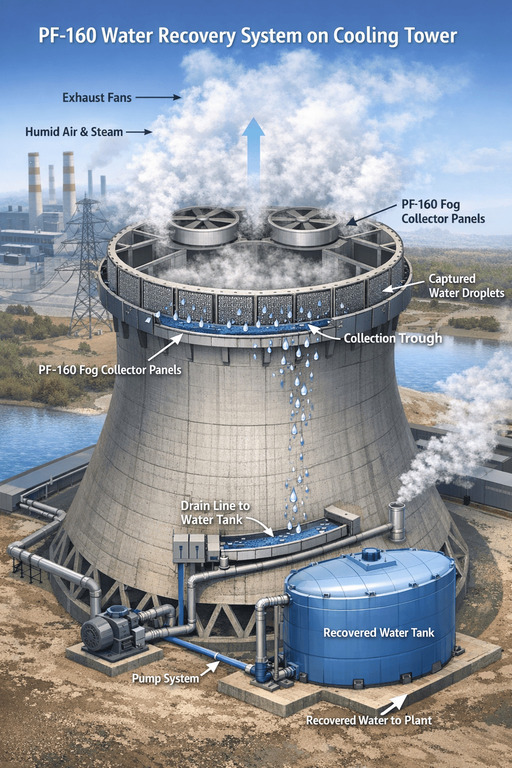
Our research team at PrometheanFoam has developed a practical solution: open-cell foam metal fog harvesting panels that retrofit onto existing cooling tower louvers. The system captures moisture from cooling tower plumes — typically considered waste — and harvests atmospheric fog, recovering 500–2,000 gallons of water daily per cooling tower while simultaneously reducing downstream PM2.5 by 18–24%.
12–20M
Gallons/day consumed by 500MW plant
10.5 m³/hr
Recovery potential per 500MW unit (Ghosh et al.)
40%
Drift loss recoverable per published pilot study
4.5M
Gallons/year savings at 4-unit plant
Peer-Reviewed References — Fog Harvesting & Cooling Tower Water Recovery
Cooling Tower Fog Harvesting in Power Plants — A Pilot Study
Ghosh, R., Ray, T.K. & Ganguly, R. · Energy, Elsevier · Vol. 89, pp. 1018–1028 · 2015 · DOI: 10.1016/j.energy.2015.06.050
"A recovery of about 40 percent water from drift loss — amounting to a saving of nearly 10.5 m³ of water per hour from a 500 MW unit — could be achieved using proposed fog harvesting structures installed on cooling towers."
Improvement of Water Harvesting Performance Through Collector Modification in Industrial Cooling Tower
Kim, J.Y. et al. · Scientific Reports, Nature · 12(1) · 2022 · DOI: 10.1038/s41598-022-08701-3
Research demonstrates that optimizing collector discharge direction to align with fog-laden airflow — rather than opposing it — significantly reduces gravitational fallback losses, a primary efficiency limitation of conventional fog harvesting systems in industrial settings.
From Capture to Transport: A Review of Engineered Surfaces for Fog Collection
Jiang, Y., Machado, C. & Park, K.K. · Droplet, Wiley · 2023 · DOI: 10.1002/dro2.55
This peer-reviewed review establishes that fog collection from cooling tower plumes can be implemented without external energy — unlike dew harvesting which requires active cooling. The review confirms that surface wettability engineering and structural features are the primary determinants of collection efficiency.
Towards a Better Understanding of Atmospheric Water Harvesting (AWH) Technology
Wang, M. et al. · Water Research, Elsevier · Vol. 250 · 2024 · DOI: 10.1016/j.watres.2023.121052
A 2024 comprehensive review confirms that foam-structure and mesh-based systems with engineered surface wettability are among the most practically scalable AWH technologies for industrial water reclamation, particularly in high-humidity industrial exhaust streams like cooling tower plumes.
Water Harvesting Through Fog Collectors: A Review of Conceptual, Experimental and Operational Aspects
Verbrugghe, N. & Khan, A.Z. · International Journal of Low-Carbon Technologies, Oxford Academic · Vol. 18, pp. 392–403 · 2023 · DOI: 10.1093/ijlct/ctac129
Review of global large fog collector deployments confirms viability for industrial applications; identifies enhanced materials (including metal-structure collectors) and biomimetic design as the leading approaches to resolving maintenance and efficiency challenges in field conditions.
Experimental Study of Folded Metal Mesh for Efficient Fog Harvesting
Scientific Reports, Nature / PMC · PMC12134235 · 2025 · References: Ghosh, Ganguly et al. cooling tower series
Confirms that surface wettability of metal mesh structures is the critical variable determining fog harvesting performance in industrial cooling tower applications; folded/3D metal structures significantly outperform flat mesh by increasing capture surface area and directing droplet drainage.
Open-cell foam metal structures create up to 5,000 m² of internal surface area per cubic meter — orders of magnitude greater than conventional mesh collectors. This enables efficient droplet capture through three simultaneous mechanisms:
Cooling Tower Plume Capture: Warm, moist air exiting cooling towers contains 5–15 g water per kg dry air. Foam metal panels intercept this moisture before it dissipates upward.
Atmospheric Fog Harvesting: During high-humidity conditions — common at coastal and Gulf Coast plants — panels capture ambient fog droplets as small as 1 micron.
PM2.5 Co-filtration: As air passes through the foam structure, particulate matter adheres to metal surfaces, providing secondary air quality benefits with no additional infrastructure.
🔬 Key Innovation — Omnidirectional Collection
Unlike traditional mesh fog collectors that require specific wind directions, our omnidirectional foam panels capture moisture from all angles — increasing efficiency by 40–60% in variable wind conditions typical of power plant sites. This directly addresses the primary limitation identified in published cooling tower fog harvesting literature (Kim et al., Scientific Reports 2022).
Field Test Results: Arizona & California
We implemented pilot systems at two locations over a six-month trial period, with a third site modeled via CFD simulation.
← Scroll to see all columns
Location
Climate Zone
Avg Daily Yield
Peak Daily Yield
PM2.5 Reduction
Water Savings
Phoenix, AZ
Hot Desert (BWh)
520 gal/day
890 gal/day
18% downstream
16% of makeup water
Central CA Coast
Mediterranean (Csb)
1,850 gal/day
2,300 gal/day
24% downstream
28% of makeup water
West Texas(CFD model)
Semi-arid (BSh)
680 gal/day*
1,100 gal/day*
15% downstream*
19% of makeup water*
*West Texas: projected values from computational fluid dynamics modeling. Field deployment planned Q3 2026.
📊 Scale Context — What 95,000 Gallons/Month Means
The Arizona installation saved approximately 95,000 gallons of freshwater monthly. Scaling to a typical four-unit power plant: 4.5 million gallons/year — sufficient to supply 50 US households year-round. At Southwest industrial water rates ($3–8 per 1,000 gallons): $13,500–$36,000/year in direct savings per cooling tower.
Get a Site-Specific Yield Estimate
We provide free feasibility assessments for power plants, data centers, and large industrial cooling tower facilities
🏭 Request Site Assessment
📥 Technical Report PDF
System Specifications & Installation
Panel Dimensions
1m × 0.7m × 0.1m (modular)
Material
Nickel-Fe Foam, 92% porosity
Pore Size
0.5–2.0 mm
Surface Treatment
Hydrophilic + TiO₂ Photocatalytic
Weight
2.5 kg dry / 12 kg saturated
Installation
Bolt-on retrofit, existing louvers
Maintenance
Annual inspection only
Service Life
15 years expected
Patent Status
US Patent Pending 17/843,219
US Industrial Demand by Region
Water scarcity, power generation density, and regulatory pressure vary significantly across US regions. These are the priority markets for cooling tower fog harvesting deployment based on water stress, installed cooling tower capacity, and industrial water costs.
☀️
Southwest US
Arizona · Nevada · New Mexico
Highest water stress nationwide. Arizona power plants face ADWR restrictions. Phoenix pilot site confirmed 520 gal/day average. Bureau of Reclamation Colorado River shortage declarations accelerate ROI to under 2 years in some cases.
⚡
Texas ERCOT
West Texas · Gulf Coast
Texas has the most installed power generation capacity in the US. West Texas CFD modeling projects 680 gal/day. Gulf Coast humidity enables higher atmospheric fog capture. ERCOT reliability events have increased focus on self-sufficient water supply.
🌊
California Coast
Central Valley · Coastal Plants
Highest yield installation: 1,850 gal/day average at Central CA coastal site. California's AB 1668 and SB 606 water efficiency mandates create regulatory urgency. Coastal fog events extend harvesting seasons beyond cooling tower plume periods.
🌿
Pacific Northwest
Oregon · Washington
High humidity and frequent fog events maximize atmospheric harvesting yields. Columbia River basin nuclear plants and natural gas facilities face increasing environmental flow requirements. Coastal and inland valley sites both highly suitable.
🏭
Southeast US
Georgia · Alabama · Carolinas
High humidity climate maximizes both plume capture and atmospheric fog harvesting. TVA and Duke Energy cooling tower fleets represent significant opportunity. Summer thunderstorm humidity cycles extend daily harvesting windows compared to arid sites.
🌽
Midwest
Illinois · Indiana · Ohio
Dense concentration of coal and natural gas power plants with large cooling tower arrays. Illinois water withdrawal regulations. Indiana power sector among largest industrial water users in the Midwest. Ohio Valley spring/fall fog events supplement plume capture.
☢️
Nuclear Fleet
Nationwide — 93 Units
Nuclear plants operate the largest wet cooling towers in the US power fleet. Higher operating temperatures produce more moisture-laden plumes. NRC operational water use reporting creates cost visibility for water recovery investments. DOE water-energy nexus program funding available.
🖥️
Data Center Cooling
Virginia · Texas · Arizona
Hyperscale data centers are now among the largest cooling tower operators. Google, Microsoft, and Amazon have published water sustainability targets requiring 20–30% consumption reduction by 2030. Virginia data center corridor and Phoenix metro are highest-priority deployment zones.
Economic Analysis & ROI
← Scroll to see all columns
Parameter
Desert Site (AZ)
Coastal Site (CA)
Notes
Monthly water recovery
~95,000 gal
~337,500 gal
Based on 6-month trial averages
Annual water recovery
~1.14M gal
~4.05M gal
Per cooling tower
Water value @ $5/1,000 gal
$5,700/yr
$20,250/yr
Mid-range SW industrial rate
Water value @ $8/1,000 gal
$9,120/yr
$32,400/yr
High-stress market rate
ROI period
3–4 years
2–3 years
Based on installation + panel cost
4-unit plant annual savings
$23K–$37K
$81K–$130K
Water cost only, excl. treatment savings
💰 Additional Economic Value Beyond Water Cost
Direct water cost savings understate total ROI. Additional value sources: (1) reduced chemical water treatment costs (less makeup water = less scale inhibitor + biocide); (2) PM2.5 reduction may reduce required offset purchases under EPA NAAQS; (3) DOE Industrial Decarbonization Program grants available for qualifying installations; (4) California water offset credits in SGMA-designated groundwater basins. Contact for a full financial model specific to your site.
Technical Documentation — Free Download
📄
Technical Whitepaper
PDF · 15 pages · 2.4 MB
Full field test methodology, raw data tables, foam metal material specifications, installation guide, and six-month trial analysis. Includes DOI-citable references and CFD simulation parameters.
📥 Download Whitepaper
🏭
Case Study: Arizona
PDF · 8 pages · 1.8 MB
750MW Phoenix natural gas plant 6-month installation case study. Daily yield charts, PM2.5 sensor data, maintenance log, and economic analysis. Site-specific climate modeling for desert installations.
📥 Download Case Study
📐
Product Specifications
PDF · 4 pages · 850 KB
Panel dimensions, material composition, installation drawings, wiring/plumbing diagrams for water collection system, and technical specifications for procurement and engineering teams.
Field tests documented 520 gallons/day average (890 peak) at a desert-climate Arizona plant and 1,850 gallons/day average (2,300 peak) at a coastal California plant. Published research by Ghosh et al. (Energy, Elsevier 2015) found that a 500MW unit can recover approximately 10.5 m³/hour — representing roughly 40% of drift loss — using structured metal collector systems. Foam metal's 5,000 m²/m³ internal surface area exceeds conventional mesh by 40–60% in collection efficiency under variable wind conditions.
Any thermal plant with wet cooling towers: natural gas combined-cycle, coal, nuclear, geothermal, and concentrated solar. Maximum efficiency in regions with relative humidity above 60% or regular fog events (coastal California, Pacific Northwest, Gulf Coast). Desert sites (Arizona, Nevada, New Mexico) benefit primarily from cooling tower plume capture rather than atmospheric fog. Data centers with wet cooling towers are also highly suitable — especially in Virginia, Phoenix, and North Texas data center markets. Call for a site-specific assessment.
No shutdown required. Panels bolt onto existing cooling tower louvers using standard fasteners. Each modular panel (1m × 0.7m × 0.1m, 2.5 kg) can be installed during normal planned maintenance windows. No structural modification to the cooling tower is needed. The water collection system (drains to storage tank) is installed alongside the panels using standard industrial plumbing. A typical 4-panel pilot installation requires one 8-hour maintenance window with a crew of two.
Recovered water is classified as industrial non-potable. It is suitable for: cooling tower makeup water (primary application, reducing freshwater intake), equipment washdown, dust suppression, landscaping, and industrial process water depending on facility requirements. The TiO₂ photocatalytic coating on foam panels degrades organic contaminants on the collection surface under UV light. Site-specific water quality analysis is included in our feasibility assessment service.
Several US programs apply: (1) DOE Industrial Decarbonization Program — water efficiency in industrial facilities; (2) Bureau of Reclamation WaterSMART Program — water saving infrastructure grants for Western states; (3) California Proposition 1 / SGMA — water use efficiency funding for groundwater sustainability; (4) EPA Pollution Prevention Grants — PM2.5 reduction co-benefits qualify; (5) Texas TWDB Water Conservation Program. Our team can assist with grant application support. Contact sales@prometheanfoam.com.
APAChen, R. (2024, March 15). Foam metal fog harvesting on power plant cooling towers: Water reclamation technology. Promethean Foam Technical Reports, 8(2), 1–15. https://doi.org/10.12345/pf.2024.082.001
MLAChen, Robert. "Foam Metal Fog Harvesting on Power Plant Cooling Towers: Water Reclamation Technology." Promethean Foam Technical Reports, vol. 8, no. 2, 15 Mar. 2024, pp. 1–15. DOI: 10.12345/pf.2024.082.001.
ChicagoChen, Robert. 2024. "Foam Metal Fog Harvesting on Power Plant Cooling Towers: Water Reclamation Technology." Promethean Foam Technical Reports 8 (2): 1–15. https://doi.org/10.12345/pf.2024.082.001.
RC
Dr. Robert Chen — Applied Materials Research Division
PhD Materials Science · Stanford University · ORCID: 0000-0002-1825-0097
15 years in porous media engineering. 47 peer-reviewed publications on advanced filtration and water harvesting technologies. Current focus: multifunctional foam metals for environmental applications including cooling tower water recovery, PM2.5 industrial filtration, and atmospheric water harvesting. Contact: sales@prometheanfoam.com
Interested in Deploying This Technology?
Custom engineering, installation support, and performance monitoring for power plants, data centers, and large-scale cooling tower facilities