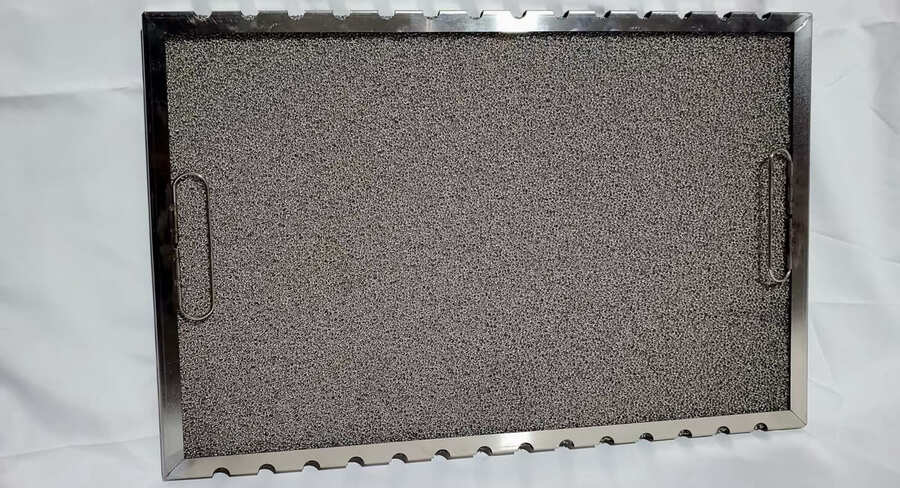
The Arizona Filter Problem No One Solves — Until Now
Phoenix is one of the most hostile environments on earth for HVAC air filters. Three forces converge simultaneously — and each one alone would be enough to destroy traditional fiber media:
- Winter temperature inversions (Nov–Feb): Cold air traps warm, pollutant-laden air at ground level. PM2.5 spikes 4–8× above baseline. Traditional HEPA clogs in 2–3 weeks.
- Desert silica dust: Arizona's fine silica falls directly in the 0.5–5μm range — the most dangerous fraction for deep lung penetration and the hardest range for conventional filters.
- Haboob dust storms: Wall clouds dump years of filter loading in a single hour. Traditional filters are permanently destroyed. Metal foam is pressure-washed and reused in 15 minutes.
Arizona homeowners replace filters every 2–3 months in good seasons — every 2–3 weeks during winter inversions. At $25–45 per filter: $270/year per HVAC unit minimum, up to $600 in bad inversion years. After a haboob: emergency replacement required. Metal foam: $159–$229 once. $0 per year after that.
During Phoenix haboob events, PM10 hourly concentrations regularly exceed 1,000 μg/m³ — in some cases exceeding 5,000 μg/m³ — far beyond both EPA daily thresholds (150 μg/m³) and WHO thresholds (45 μg/m³).
View on PubMed / Google ScholarThis peer-reviewed review confirms that fine silica particles (PM2.5) from desert dust fall in a bimodal distribution combining coarse sand with fine respiratory-penetrating particles, and recommends alert systems to protect vulnerable populations during dust episodes.
View on ACS PublicationsMineral desert dust is primarily silica (SiO₂). Particles under 2.5 μm diameter (PM2.5) penetrate deeply into lung alveoli, enter the bloodstream, and are associated with respiratory illness, cardiovascular disease, and premature mortality.
View on ScienceDirectA global scoping review of desert dust health effects found consistent evidence linking PM2.5 exposure during dust episodes to respiratory and cardiovascular outcomes; the threshold-based PM exceedance method is the standard for evaluating dust event severity.
View on Wiley / Google Scholar3 Capture Mechanisms, One 3-Zone Architecture
Traditional HEPA filters use a single mechanism: mechanical entrapment in fiber media. It works — until it fills. In Arizona, it fills in weeks. Metal foam uses three simultaneous mechanisms, each targeting a different slice of Arizona's bimodal dust particle distribution.
Large particles can't follow curved airflow around the metal skeleton — they impact and stick. Pre-filters heavy haboob loads before the PM2.5 zone. Extends Zone 2 lifespan 3–4×.
Particles follow airflow but pass within one radius of the metal skeleton — they contact and are captured. Core zone tuned to Arizona's bimodal dust distribution (0.3–0.6mm pores).
Fine silica <3μm moves randomly due to molecular collisions — statistically collides with the tight outlet zone (0.1–0.3mm pores). This is the lung-penetrating fraction that causes silicosis and cardiovascular damage.
Arizona dust has a bimodal distribution: coarse sand (>10μm from haboobs) plus fine silica (0.5–5μm traveling far from source). A uniform-pore filter tries to do everything and does nothing well. The 3-zone architecture separates these tasks, extending effective lifespan 6–8× compared to uniform-pore configurations.
Arizona-Tuned Physical Specifications
| Parameter | Arizona Value | Rationale | vs Standard |
|---|---|---|---|
| Porosity | 75–85% | High dust mass load without premature pressure drop | Standard: 90–95% (humidity apps) |
| Residential Thickness | 5–8 mm | 3-zone capture without excessive HVAC pressure | Standard: 8–12 mm |
| Commercial Thickness | 8–10 mm | Higher face velocity, heavier commercial loading | Standard: 10–15 mm |
| Zone 1 (Inlet) | 1.0mm+ pores · 10% area | Pre-filters haboob coarse load | Extends Zone 2 life 3–4× |
| Zone 2 (Core) | 0.3–0.6mm pores | Primary PM2.5 capture zone | 92.4% efficiency maintained |
| Zone 3 (Outlet) | 0.1–0.3mm pores | PM1.0 polishing layer | <2% penetration at rated flow |
| Surface Coating | Hydrophilic | Monsoon season moisture drainage; evaporative cooler compatible | Enhances July–Sep performance |
| Frame | 304 Stainless Steel | 120°F heat, UV, ozone, cooler moisture | No polymer degradation |
| Temperature Rating | 1,650°F | Arizona 120°F summer is completely irrelevant | vs polymer: degrades at heat |
Head-to-Head: Metal Foam vs HEPA Under Arizona Conditions
3 Arizona Case Studies
Traditional filters required weekly replacement during winter inversions, causing HVAC downtime and ASHRAE air quality breaches. After metal foam: 14-week cleaning cycle, zero emergency replacements after haboobs, ASHRAE compliance year-round.
Previous: quarterly replacement at $650 + $400 labor = $4,200/year. After metal foam: $1,800 installation, $800/year cleaning labor, $0 replacements. 5-year savings: $11,400. Zero unplanned replacements in 5 years.
One $219 purchase. Washed every 3 months. Compatible with evaporative cooler used during shoulder seasons. Previous: $270/year filter cost ($400+ in bad inversion years). Evaporative cooler was destroying fiber filters within weeks during spring.
Arizona Demand by City — Where 300+ Installs Are
Metal foam PM2.5 filters are installed across Arizona from Flagstaff to Tucson. Each city has different primary challenges — here's the specific air quality context for each market.
Maricopa County's worst AQI periods. Brown cloud inversions trap silica, vehicle emissions, and construction dust. Central Phoenix, West Phoenix dust corridor, and South Mountain area most affected. 200+ installs.
McDowell Mountain proximity generates heavy haboob events. High-end residential HVAC systems and Scottsdale's growing data center campus demand premium PM2.5 filtration.
Mesa's industrial east valley combined with residential density creates heavy mixed-use PM2.5 loads. Chandler's semiconductor manufacturing (Intel) demands clean-room-grade air quality. 40+ installs.
ASU campus and rapid suburban expansion in Gilbert bring residential demand. Salt River bed generates unique local haboob events. Evaporative cooler use is high — metal foam's cooler compatibility is critical.
Tucson basin wind patterns and proximity to agricultural areas create year-round dust loading. University of Arizona campus and biomedical research facilities require consistent air quality. 60+ installs.
At 7,000 ft elevation, Flagstaff's challenge is pine pollen and wildfire smoke rather than desert silica. Metal foam's washable structure handles pollen season without replacement. NAU campus demand growing.
Arizona Maintenance Protocol
| Environment | Inspect | Clean | Method | Lifespan |
|---|---|---|---|---|
| Phoenix Residential | Every 3 months | Every 3–4 months | 5-min garden hose | 12+ years |
| Commercial HVAC | Monthly | Every 2 months | Pressure washer | 10+ years |
| Automotive (AZ fleets) | Every 6 months | Twice yearly | Compressed air + rinse | Vehicle lifespan |
| After any haboob | Immediately | 15-min pressure wash | Garden hose 40 psi | 100% restored |
| South AZ Industrial / Mines | Monthly | Monthly | Dedicated cleaning station | 7–9 years extreme |
Step 1 (2 min): Remove filter. Inspect — if dark tan/brown discoloration, proceed immediately.
Step 2 (10 min): Pressure wash outlet→inlet direction with garden hose (30–60 psi). Rinse until water runs clear. Extreme haboob: 2-min soak first.
Step 3 (3 min): Shake dry, 15-min air dry, reinstall. 100% efficiency restored. Traditional alternative: drive to hardware store, buy new filter ($25–45), install — 30+ minutes, 100% cost.