The Problem AC Cannot Solve — And Why Copper Can
Traditional air conditioning dehumidification has a fundamental physics limitation: the evaporator coil must be colder than the dew point to extract moisture from air. In practice, this means below approximately 68–72°F indoor temperature, your AC's dehumidification function becomes nearly useless — the system is too warm to condense moisture efficiently.
Florida homeowners know this intimately: spring mornings at 65°F with 80% relative humidity, the AC isn't running hard enough to dehumidify, and the house feels clammy and damp. Houston office buildings in October. Singapore at any time of year. Shanghai from April through September.
The three failure modes of traditional dehumidification are structural — they cannot be engineered away within the mechanical paradigm:
- Temperature dependency: AC loses dehumidification below 72°F. Desiccant systems consume 1–5 kW for thermal reactivation.
- Energy waste: Cooling air just to remove moisture wastes 35–50% of the energy consumed.
- Mechanical complexity: Compressors, condensers, refrigerants — all fail, all require maintenance, all have 10–15 year lifespans.
Copper foam solves all three simultaneously through passive physics — no refrigerant cycle, no compressor, no electricity consumption beyond the existing HVAC fan.
The Physics: Why Copper Foam Condensates Passively
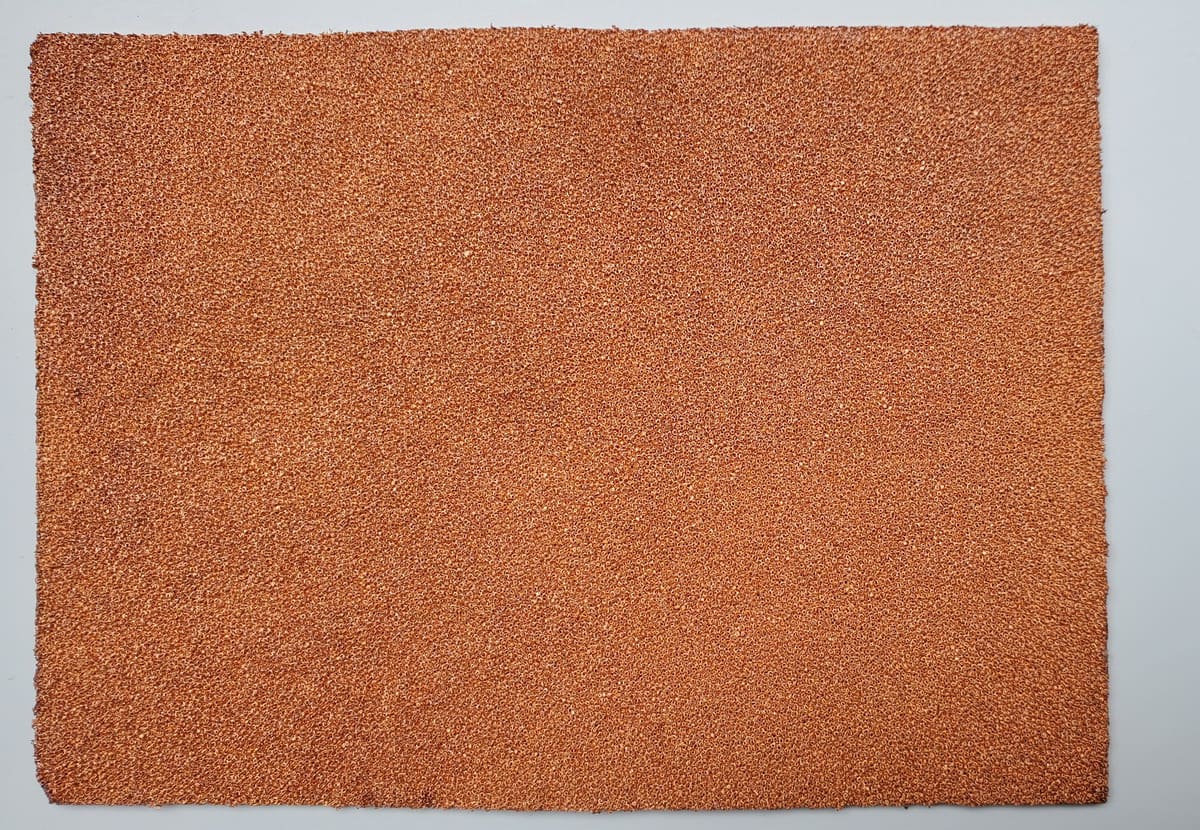
Surface Area — The Basketball Court in Your HVAC Duct
A single cubic inch of copper foam at 90% porosity provides approximately 300 square inches of internal condensation surface. Scale that up: a 15mm-thick filter sized for a standard residential HVAC duct contains the equivalent of a basketball court of condensation surface in a piece of material the size of a large book.
Water vapor molecules need to contact a surface to phase-change to liquid. More surface area = more condensation events per unit of air volume = more moisture removed per pass.
Thermal Conductivity — Copper Does the Work, Not the Compressor
Copper has a thermal conductivity of 400 W/m·K — one of the highest of any commercial material. This means the foam rapidly equilibrates with local air temperature, creating a surface temperature that's very slightly below the bulk air temperature due to evaporative effects at the surface.
This small temperature differential — not a compressor-driven refrigerant cycle — is sufficient to trigger condensation on the foam surface at ambient temperatures. The dew point of 80% RH air at 75°F (24°C) is approximately 69°F (21°C). The copper foam surface reaches that temperature passively. Condensation occurs. Moisture drains.
Optimized Parameters for Maximum Dehumidification
| Parameter | Optimal Value | Performance Impact | Application Notes |
|---|---|---|---|
| Porosity | 90–95% | More surface area + lower pressure drop | 92–94% optimal for HVAC retrofit |
| Primary Pore Size | 0.8–1.2 mm | Primary condensation sites | Florida/Singapore: standard |
| Secondary Pores | 0.5–0.8 mm | Enhanced capillary action | Draws condensate toward drainage channel |
| Thickness — Residential | 10–15 mm | Ideal for retrofit | Florida homes: 15mm standard |
| Thickness — Commercial | 15–20 mm | Higher face velocity applications | Miami office: 18mm installed |
| Thickness — Industrial | 20 mm | Maximum moisture removal | Jacksonville warehouse: 20mm |
| Material — Coastal/High RH | Copper (400 W/m·K) | Maximum thermal conductivity | Florida coast, Singapore, Dubai |
| Material — Inland | Aluminum (237 W/m·K) | 65% lighter, economical | Inland Florida, Texas, Shanghai inland |
| Surface Coating | Hydrophilic | Contact angle <30° · 3× drainage | Standard on all installations |
| Air Velocity | 1.0–2.5 m/s | Balanced capture vs. pressure drop | Standard HVAC fan: no changes needed |
| Pressure Drop | 5–15 Pa | Negligible HVAC impact | Equivalent to a clean standard filter |
| RH Reduction | 70% → 40–50% | Single air pass, design conditions | Validated Tampa, Miami, Singapore |
Copper Foam vs AC vs Desiccant: Full Comparison
- Fails below 72°F — won't dehumidify
- 1.5–3.0 kW continuous when running
- Compressor life: 10–15 years
- Refrigerant: leaks, refills, environmental impact
- Annual maintenance: $200–800
- 35–50% energy wasted on cooling, not drying
- Works at low temperatures
- 1.0–5.0 kW for thermal reactivation
- Desiccant lifespan: 5–8 years
- Reactivation heater maintenance required
- Desiccant wheel replacement: $500–2,000
- Moderate at high humidity, best in dry climates
- Works 59°F–86°F — full spectrum
- 0 kWh beyond existing HVAC fan
- Lifespan: 20+ years (copper)
- No refrigerant, no compressor, no desiccant
- Maintenance: periodic water rinse only
- $219–$499 one-time · $0 annual
Humidity Reduction: Before vs After
Houston spring · Shanghai monsoon
→ Mold risk · discomfort · damage
Mold prevention threshold: <60% RH
→ Comfort · protection · health
Global Deployment Map: Where This Works Best
Passive copper foam dehumidification delivers its highest ROI in climates with sustained high relative humidity — where traditional AC dehumidification is most inadequate or most expensive to operate.
Fort Lauderdale · Pensacola · Naples
Daytona Beach · Key West · Gainesville
Corpus Christi TX · Baton Rouge LA
Savannah GA · Charleston SC
Wilmington NC · Virginia Beach VA
Seattle WA (winter)
Portland OR (winter)
New York NY (summer)
Bangkok · Ho Chi Minh City
Kuala Lumpur · Jakarta
Manila · Yangon
Chongqing · Wuhan · Hangzhou
Nanjing · Suzhou · Fuzhou
Chengdu · Kunming
Dubai · Abu Dhabi · Doha · Kuwait
Tokyo · Osaka (summer)
Taipei · Hong Kong
Why These Geographies Make Copper Foam ROI-Positive in <2 Years
All these locations share two properties: (1) sustained high relative humidity that cannot be ignored — it damages buildings, stored goods, electronics, and human health — and (2) ambient temperatures that frequently fall into the range (15°C–25°C) where AC dehumidification is inefficient or inactive. Copper foam operates optimally in precisely this gap.
In Singapore at 28°C / 85% RH year-round: copper foam runs 24/7 passively. In Shanghai April–September: 80%+ RH while temperatures swing 20°C–35°C — a range that makes AC-only solutions both inadequate and expensive. Custom configurations available for any climate zone →
Validated Results: Three Real Installations
Installation: 15mm copper foam in existing HVAC ductwork, single retrofit. Tampa average summer RH: 75–88%. Spring and fall shoulder seasons: AC insufficient for dehumidification at 65–70°F ambient.
Before: 72–80% RH during shoulder seasons, mold growth in bathroom and closets, $340/year in dehumidifiers + filters + remediation.
Installation: 18mm aluminum foam in makeup air system. Miami average RH: 74% annual, 84% summer. Pre-installation: $8,400/year in AC electricity for dehumidification cycle during humidity peaks.
After: Foam handles 35% of the total humidity load passively, reducing AC dehumidification cycling significantly.
Challenge: Seasonal moisture damage to stored electronics and precision equipment. Traditional dehumidifier array cost: $6,200/year in electricity + maintenance. Target: maintain ≤55% RH.
Solution: 20mm copper foam panels in ventilation system throughout 40,000 sq ft warehouse.
Calculate Your Savings: Copper Foam vs Traditional Dehumidification
Energy Consumption: The Number That Changes Everything
The single most important difference between copper foam and every alternative is the operating energy profile. Everything else — price, maintenance, lifespan — follows from this one fact.
Seasonal Humidity Data: When Copper Foam Works Hardest
Passive copper foam dehumidification effectiveness correlates directly with ambient RH. These seasonal data points show when the ROI is highest for each key market — and when AC dehumidification is most likely to fail.
| City | Jan–Mar RH | Apr–Jun RH | Jul–Sep RH | Oct–Dec RH | AC fails at | Foam ROI |
|---|---|---|---|---|---|---|
| Tampa, FL | 65% | 72% | 86% | 68% | Spring / Fall | ★★★★★ |
| Miami, FL | 71% | 78% | 84% | 74% | Year-round | ★★★★★ |
| Houston, TX | 68% | 76% | 80% | 65% | Spring / Fall | ★★★★★ |
| New Orleans, LA | 72% | 79% | 85% | 71% | Spring / Fall | ★★★★★ |
| Singapore | 84% | 82% | 83% | 85% | Never — year-round | ★★★★★ |
| Shanghai | 72% | 78% | 85% | 72% | Winter months | ★★★★★ |
| Guangzhou | 76% | 83% | 88% | 73% | Winter months | ★★★★★ |
| Mumbai | 68% | 72% | 91% | 71% | Oct–May | ★★★★★ |
| Bangkok | 75% | 82% | 85% | 80% | Dec–Jan cooler | ★★★★★ |
| Dubai | 61% | 57% | 65% | 63% | Coastal only | ★★★☆☆ |
| Tokyo | 51% | 65% | 78% | 58% | Summer peak | ★★★★☆ |
| Honolulu, HI | 69% | 68% | 70% | 71% | Mild AC use | ★★★★★ |
| Savannah, GA | 66% | 74% | 82% | 67% | Spring / Fall | ★★★★★ |
Ready to Eliminate Humidity Permanently?
From Tampa residential to Singapore data centers. Sample kit includes copper and aluminum foam — test in your HVAC before committing.