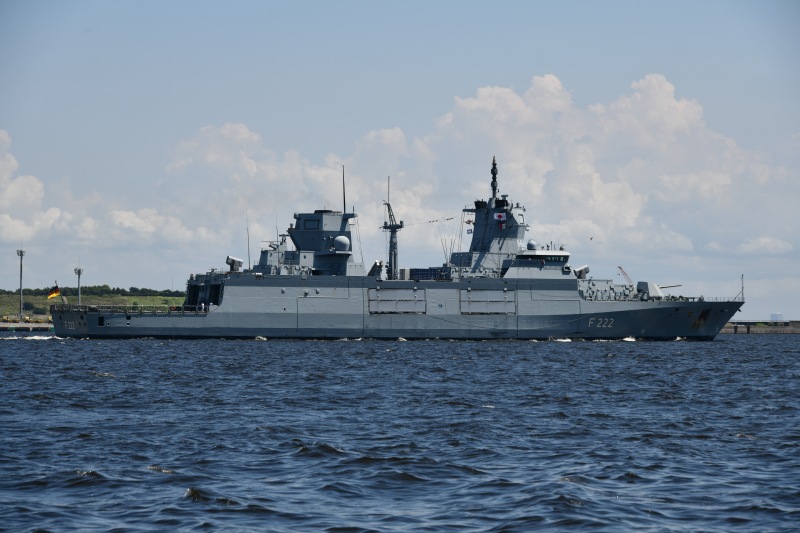
In early 2024, defense analysts noted a revealing moment at a NATO-affiliated conference in Germany. According to open-source reports, a senior German naval officer delivered an extensive presentation on the operational benefits of traditional maritime signaling methods. The officer described how, during a Pacific deployment, he had ordered his flotilla to power down all electronic systems and rely solely on century-old spotlight communication techniques.
The presentation framed this as a proactive exercise in operational resilience. However, informed sources later clarified the context: during prior operations in contested waters, the vessels had experienced such intense electronic suppression that their communications and sensor systems became inoperative. The switch to visual signaling wasn't strategic choice—it was operational necessity.
This incident represents more than an operational anecdote—it signals a fundamental shift in naval warfare where electromagnetic spectrum dominance determines tactical advantage.
The Evolving Electronic Warfare Landscape
Modern naval platforms face increasingly sophisticated electromagnetic threats across multiple domains. From commercial-grade jammers to state-sponsored electronic warfare systems, the ability to deny spectrum access has become a critical asymmetric capability.

The Tactical Challenge:
- Broadband Saturation: High-power jamming across wide frequency ranges overwhelms receiver front-ends
- System Degradation: Compromised electronics generate internal interference cascades
- Operational Paralysis: Loss of C4ISR capabilities forces tactical regression
- Platform Vulnerability: Exposed systems become targeting beacons for anti-radiation weapons
When advanced warships revert to visual signaling protocols, it represents not just a communications challenge, but a complete breakdown of the network-centric warfare paradigm that has defined naval operations for decades.
Limitations of Conventional Shielding Approaches
Traditional electromagnetic shielding methods face significant limitations against modern electronic warfare threats:
Conventional Shielding vs. Modern Requirements
| Parameter | Traditional Solid Shielding | Modern Operational Requirements |
|---|---|---|
| Frequency Coverage | Narrowband optimization | Broadband (1-40 GHz+) |
| Weight Penalty | Significant (15-25% of system weight) | Minimal impact on platform performance |
| Integration Complexity | Major structural modifications | Conformal application to existing structures |
| Multi-Threat Protection | Limited to specific threat profiles | Simultaneous protection across EM spectrum |
The fundamental challenge lies in protecting systems that must remain electromagnetically "visible" to function—antennas, sensors, and communications arrays that cannot be fully enclosed in traditional Faraday cage configurations.
Porous Metal Matrix Technology: A Next-Generation Solution
At Promethean Foam, our engineered porous metal matrices represent a paradigm shift in electromagnetic protection. Unlike solid shielding materials that primarily reflect incident energy, our graded-impedance structures dissipate electromagnetic energy through multiple scattering mechanisms.
Key Technical Advantages
Broadband Attenuation: Our materials provide effective shielding across the complete operational spectrum from 1 GHz to 40 GHz, covering communications, radar, and electronic warfare bands.
Weight Optimization: The porous structure achieves 35-45% weight reduction compared to solid metal equivalents while maintaining or exceeding shielding performance.
Conformal Integration: Engineered for direct application to complex surfaces including mast structures, antenna farms, and equipment enclosures without major structural modification.
Validated Performance: Independent testing confirms compliance with MIL-STD-461, DEF STAN 59-411, and NATO standardization agreements.
Ready to Enhance Your Platform's EM Resilience?
Our defense solutions team specializes in custom shielding applications for naval, aerospace, and critical infrastructure platforms.
Application Scenarios and Integration Pathways
Our technology supports multiple implementation pathways for naval platforms:
New Construction Integration
Design-phase integration allows optimal material placement and structural consideration, minimizing weight impact while maximizing protection coverage.
Retrofit and Modernization
Existing platforms can be upgraded with modular shielding kits that address critical vulnerability points without extensive dry-dock periods.
Critical System Protection
Targeted shielding for command centers, communications nodes, and sensor arrays provides layered protection architecture.
Performance Validation and Certification
All Promethean Foam defense materials undergo rigorous independent testing:
Shielding Effectiveness Performance Data
| Frequency Band | Primary Applications | Attenuation (dB) | Weight Reduction |
|---|---|---|---|
| L-band (1-2 GHz) | Satellite Communications, ATC | >42 dB | 38% |
| S-band (2-4 GHz) | Surface Search Radar, Data Links | >40 dB | 38% |
| C-band (4-8 GHz) | Fire Control, Weather Radar | >38 dB | 35% |
| X-band (8-12 GHz) | Navigation, Targeting Radar | >35 dB | 35% |
Strategic Implications and Future Developments
The incident described at the beginning of this analysis represents more than an isolated operational challenge. It signals the maturation of electronic warfare capabilities that can fundamentally alter naval engagement dynamics.
Platforms that maintain electromagnetic functionality in contested environments retain critical advantages:
- Continuous Situational Awareness: Maintaining sensor and communications capability during spectrum denial operations
- Tactical Initiative: The ability to operate when adversary systems are degraded
- Force Protection: Reduced electromagnetic signature lowers targeting vulnerability
- Operational Flexibility: Maintaining full capability across the conflict spectrum
In future naval engagements, electromagnetic resilience may prove as critical as armor protection or weapons systems. The ability to maintain functionality in contested spectrum environments represents a fundamental competitive advantage.
Conclusion: Beyond Signal Lamps
The anecdote of naval forces reverting to visual signaling methods should serve as a catalyst for electromagnetic defense investment, not as an accepted contingency. As electronic warfare capabilities proliferate across state and non-state actors, electromagnetic resilience must be engineered into platforms from initial design through lifetime modernization.
At Promethean Foam, we partner with naval architects, system integrators, and fleet operators to implement next-generation shielding solutions that maintain operational capability across the electromagnetic spectrum. Because in modern naval warfare, the ability to communicate by light should remain a training exercise—not an operational reality.
Disclaimer: This analysis is based on open-source reporting and technical analysis. All performance data represents independent laboratory testing results. Promethean Foam materials are designed for legitimate defense applications and comply with all applicable export control regulations.